

There are seasons when life is technically good. The prayers you prayed years ago are sitting right in front of you. The responsibilities. The community. The calling. You are living something you once asked God for. And yet – everything feels muted.
Not tragic. Not catastrophic. Just… gray.
I’ve learned that gray does not always announce itself dramatically. Sometimes it settles in quietly. You don’t notice it at first. You just realize one day that you are moving through your life like you’re looking at it through frosted glass.
You are functioning. You are showing up. But the warmth feels distant. And there is a particular kind of ache in living a life you once desired and wondering why it feels harder than you imagined.
Gray Is Not Faithlessness
In the song “Color” by Ellie Holcomb, the metaphor of sorrow draining vibrancy from the world is simple but profound. When we are grieving, anxious, disappointed, or quietly overwhelmed, the world can lose its saturation.
But gray is not sin. Gray is not ingratitude. Gray is not a failure of trust. Sometimes gray is grief without a funeral.
It is the tension of longing stretching longer than expected. It is carrying responsibility while feeling emotionally thin. It is hoping – and waiting – and hoping again.
Scripture never denies the gray.
- “Weeping may endure for a night…” (Psalm 30:5)
- Beauty for ashes. (Isaiah 61:3)
- New mercies every morning. (Lamentations 3:22–23)
These verses are not commands to feel immediate joy. They are reminders that muted seasons are not permanent ones.
Our Lady of Sorrows and the Architecture of Sorrow
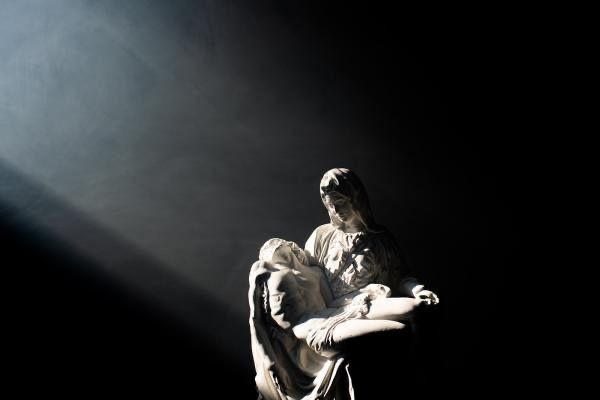
Under the title Our Lady of Sorrows, the Blessed Mother is not depicted triumphant – she is pierced. Quiet. Steady. Waiting. What moves me most is that her sorrow unfolded in stages. The Church reflects on the Seven Sorrows – not one catastrophic moment, but a lifetime of pierced expectations:
- Simeon’s prophecy that a sword would pierce her soul.
- The flight into Egypt.
- Losing Jesus in the temple.
- Meeting Him on the road to Calvary.
- Standing at the foot of the Cross.
- Holding His lifeless body.
- Placing Him in the tomb.
None of these moments looked colorful. Each sorrow dismantled a layer of expectation. Each one invited her into deeper surrender. But notice something: she did not abandon the story.
She remained present through prophecy, displacement, confusion, public humiliation, and devastating loss. She did not demand immediate explanation. She did not rush ahead to Resurrection.
She endured Good Friday without visible evidence of Easter. Gray, for Mary, was not the absence of God. It was participation in redemption.
The Interior Sword
There is a particular line in the prophecy of Simeon:
“And you yourself a sword will pierce…” (Luke 2:35).
The sword was not physical. It was interior. Many of our gray seasons are interior swords. They are not obvious to others. They do not always have visible drama attached. They are carried quietly.
Sometimes the sword is:
- The ache of delayed vocation.
- The weight of mental exhaustion.
- The fear that you are not becoming who you thought you would be.
- The dissonance between hope and timeline.
These are not loud crosses. But they pierce all the same. Like Mary, we often carry them silently.
Even Prophets Collapse

There is a moment in Scripture that always humbles me. After one of the greatest spiritual victories in the Old Testament, the prophet Elijah fled into the wilderness. Overwhelmed. Afraid. Depleted. He sat beneath a tree and asked God to let him die.
And what did God do? He let him sleep. Then He fed him. Then He let him sleep again. Before correction, before mission, before explanation. Rest.
Sometimes our gray is not a crisis of faith. It is a body and nervous system that have been bracing too long. God does not always respond to exhaustion with rebuke. Sometimes He responds with bread.
Why We Fear the Gray
We fear muted seasons because they make us question ourselves. If nothing catastrophic has happened, why do I feel heavy? If I trust God, why does joy feel distant? If I am blessed, why does it feel hard?
But winter is not failure. Winter is conservation. Roots deepen in darkness. Systems strengthen beneath frozen ground. What looks barren above is often protected below.
Gray can be pruning. Gray can be strengthening. Gray can be sacred preparation. Mary’s sorrow did not negate God’s promise. It matured her capacity to hold it.
The Resurrection She Could Not See
Here is what I think about often: On Holy Saturday, everything still looked gray. There was no visible resurrection yet. Only silence.
Mary had every reason, humanly speaking, to collapse into despair. And yet the Church has long reflected that she held hope when others scattered. She did not manufacture Easter. She waited for it.
Color returned – not because she forced it, but because redemption was already in motion beneath the surface. And that is what we forget in our gray seasons.
God is not inactive because you cannot see saturation. He is working beneath the soil.
The Slow Return of Color

Color rarely reappears dramatically. It returns in gradients. A day that feels 5% lighter. A moment of laughter that surprises you. A desire to create again. A flicker of anticipation.
We miss these because we are waiting for fireworks. God often restores in tints before tones. The same Mother who stood at the Cross eventually saw the empty tomb. And the same God who allowed sorrow to pierce her is the God who brought life from what looked like permanent loss.
If You Are in a Gray Season, you are not behind. You are not spiritually deficient. You are not disappointing God. You may simply be in a chapter that looks like Holy Saturday – quiet, unresolved, waiting. Gray is not the end of your story. The canvas is not finished. The God who stood beside a pierced Mother is still standing beside you.
Color will return. Not because you forced joy. Not because you shamed yourself into gratitude. Not because you pretended it didn’t hurt, but because resurrection is woven into the very rhythm of redemption. Winter never has the final word.


Leave a comment